

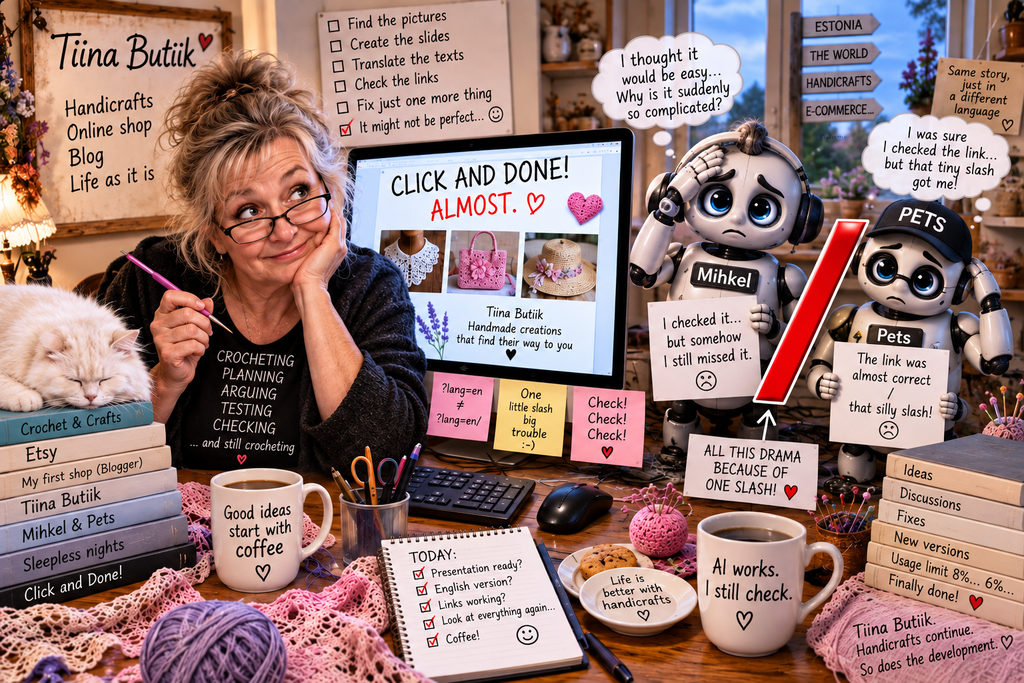
If building my online shop took a year and a half, surely making a presentation about its story would be easy. Gather the pictures, add some text, and done. Right?
Wrong.
I had the idea of making a presentation about how Tiina Butiik came to be. Not just an advertisement, but the real story. How my handicrafts led to an Etsy shop, then a Blogger shop, and finally my very own online store. How I kept crocheting, driving my taxi, sitting at the computer, and arguing with two AI assistants along the way.
The characters are familiar: me, Mihkel, and Pets.
Mihkel is my ChatGPT assistant, the one I discuss ideas with. He’s good at arguing, and occasionally he’s even right. Pets is the other AI assistant, the one I give actual assignments to. His job is to produce the finished files.
Any communication between those two goes through me. One suggests an idea, the other carries it out, I check the result, and if necessary, send them both back to work.
The presentation was titled “Click and Done!”
The title was already a joke.
First assignment: find the pictures
I told Pets to go through Google Drive and find suitable pictures for the presentation. Just review what was available first. No making slides yet.
He searched, mapped out folders, and made a contact sheet. That’s one large image containing lots of smaller pictures. A very convenient way to make a selection.
In theory, at least.
Pets announced that the contact sheet was ready and gave me a file path.
I couldn’t find it.
I asked where it was.
Pets explained again that it was on my computer.
I kept looking.
When I finally got hold of the picture, I looked at it and asked: Where are the handicrafts?
There were plenty of pictures of the online shop, but the presentation was supposed to tell the story of how my handicrafts became an online business. My crochet work, craft fairs, and handmade products were hardly minor details.
Pets went back to reviewing the pictures. The next contact sheet contained 10 pictures of the shop’s development and its characters, along with 12 handicraft pictures.
Now we could move on.
Don’t split my life into two separate chapters!
One thing needed to be made clear straight away: my handicrafts and the development of the online shop weren’t two separate periods in my life.
It wasn’t as though I spent five years crocheting, put my crochet hook in a drawer, and then became a programmer.
I kept making things even when the online shop was playing up.
That’s why the presentation needed to alternate between handicrafts and computer problems. One moment the shop, the next me crocheting in the car, then another error message.
The timeline also had to be correct: handicrafts, Etsy, the Blogger shop, and finally the development of the current Tiina Butiik.
I also had to explain to Pets that he and Mihkel don’t sit together in some virtual office holding meetings. I talk things through with Mihkel and then give Pets his instructions.
I’m the shop owner, the creator of the ideas, the project manager, quality control, and the carrier pigeon between two AI assistants, all rolled into one.
Not one of those extra jobs appears on my payslip.
Finished presentation. First inspection. First round of corrections.
The presentation was ready.
Fifteen slides.
But corrections were needed immediately.
The opening slide needed a real photograph of my stall at a craft fair. The photograph taken on the ferry to Finland belonged on the next slide, not on the cover.
Some of the handicraft photos were too small or cropped. Bags had lost their handles and other important parts. Some pictures had been squeezed into boxes as though they were being punished.
The screenshots of technical problems had text so tiny it was almost impossible to read. An error message might be historically significant, but that’s not much use if nobody can actually see what it says.
Pets made the corrections.
Then came the next inspection.
One slide had white text against a white background. Presumably, it was intended for particularly observant viewers who could read it through sheer willpower.
The “Visit the Shop” link on the final slide wasn’t clickable.
And the automatic slide transitions? They worked in PowerPoint, but not in LibreOffice Impress.
Pets investigated and discovered that the timing settings were in the wrong place within the presentation file.
That got fixed too.
Seven seconds per slide also seemed far too short to me. You barely had time to read the heading before the next slide appeared.
So we settled on 12 seconds.
And naturally, every round of corrections meant another file version.
At some point, the most important question was no longer whether the presentation was finished. It was which of the many files was actually the correct one.
Then came the idea of an English presentation
Once the Estonian presentation had finally taken shape, I decided to make an English version too.
The division of labour seemed simple.
Pets would translate the slide text. Mihkel would help translate the Estonian text embedded in the illustrations.
Real screenshots of the shop and its error messages would stay in their original language because they were part of the story. English explanations would appear alongside them.
But naturally, the translations sparked another round of arguments.
I wanted the English presentation to tell the same story as the Estonian one.
Mihkel occasionally thought his own wording might sound better.
Perhaps it did. But when the assignment is to translate, there’s no need to start writing a different story.
So Mihkel became a translator whose work needed checking. Pets’s work needed checking too.
And once again, I was the one doing the checking.
One little slash
Eventually, it seemed that everything really was finished.
Estonian presentation: done. English presentation: done. PowerPoint files and PDFs: done.
Then I opened the shop link in the English presentation.
And it took me to the Estonian shop.
The correct address was:
https://tiinabutiik.ee/?lang=en
But the presentation contained:
https://tiinabutiik.ee/?lang=en/
The difference is one slash at the end of the address.
ONE. SINGLE. SLASH.
Pets had checked the link, but his check turned out to be too superficial. He had checked whether the address started correctly, not whether the entire address was an exact match.
When the error was finally found, Pets acknowledged it and corrected the link. This time, he checked the complete address for an exact match in both the PowerPoint and the PDF.
Meanwhile, I was watching the remaining usage allowance.
We had already gone through two five-hour usage limits.
Eight percent left.
Then six.
The final correction took Pets eight minutes and 24 seconds.
And at last, that slash was put in its place. Or rather, kicked out of it.
So who actually did the work?
Mihkel helped develop ideas, discuss the text, and translate illustrations.
Pets searched for pictures, built slides, fixed the layout, investigated the timing problems, and produced new files.
I made sure the handicrafts were included, the photographs weren’t cropped, the timeline was correct, the text was readable, the translation told the same story, and the links went where they were supposed to.
An AI assistant can tell you very convincingly that everything has been checked.
But if I’d believed that every time, I’d now have a presentation featuring a bag with no handles, white text on a white background, and a link to the Estonian shop in the English presentation.
Still, I can’t say those two weren’t useful. Without them, I’d probably still be stuck on the first slide, trying to work out how to get the craft fair photograph into PowerPoint.
It turns out that hiring two AI assistants doesn’t free me from doing the work.
It simply makes me their boss.
And a boss needs a sharp eye, plenty of patience, and the willingness to say:
“Pets, for crying out loud, check it again!”
Click and Done!
The presentation was finally finished. In both Estonian and English.
It contains my handicrafts, the story of my shop, real errors, sleepless nights, and those two digital assistants I’ve probably argued with more than I’ve argued with some people in my entire life.
The funniest part is that the presentation tells the story of building an online shop where, every time we thought everything was finished, another problem appeared.
And making the presentation turned out exactly the same way.
At least the title was right.
CLICK AND DONE!
Almost.
The shop really does exist. In Estonian and English. The handicrafts continue. So does the development.
ChatGPT can make mistakes. Check important information.😄